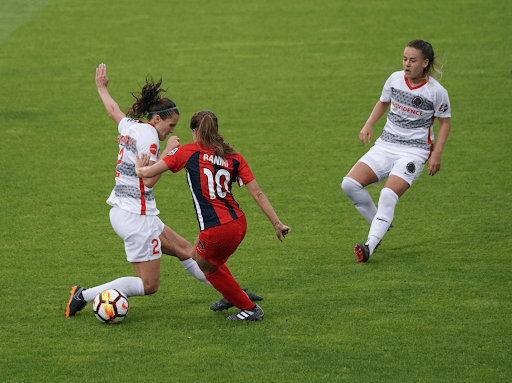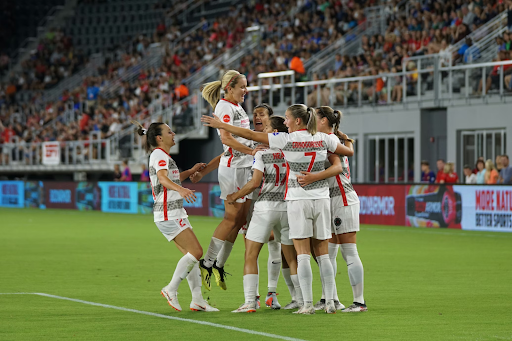
Women’s soccer has never been just about the final score. Behind every match are years of struggle and persistence — stories that don’t always make it into highlight reels or postgame coverage. Books offer a deeper way in, capturing the moments that shaped the women’s game, the people who pushed it forward and the cultural forces that helped it grow. For longtime supporters, these stories add texture and context to what’s happening on the pitch today. For newer fans, they show how women’s soccer became the global, must-watch sport it is now, and why its history matters just as much as its future.
1. “Go for the Goal” by Mia Hamm
Mia Hamm is one of the most influential figures in women’s soccer history, best known for her role in elevating the U.S. Women’s National Team to global prominence in the 1990s and early 2000s. A two-time FIFA Women’s World Cup champion and Olympic gold medalist, Hamm became a household name at a time when women’s soccer was still fighting for mainstream recognition.
Unlike later memoirs that wrestle with fame or federation politics, “Go for the Goal” reflects an earlier moment in women’s soccer, when visibility itself was the victory. Hamm focuses on fundamentals — setting goals, trusting teammates, handling pressure — through stories drawn from youth soccer, World Cup runs and Olympic competition. The book’s straightforward, encouraging tone mirrors Hamm’s public role during the sport’s formative years, when inspiring the next generation was as important as winning titles.
2. “Breakaway: Beyond the Goal” by Alex Morgan
Alex Morgan is one of the defining players of women’s soccer’s modern era, winning two FIFA Women’s World Cups (2015, 2019) and an Olympic gold medal (2012) while becoming a central figure in the sport’s global popularity. Her career coincided with the rapid expansion of professional leagues, sponsorships, and media coverage in the 2010s.
Where Morgan’s earlier writing centers on on-field development, “Breakaway: Beyond the Goal” widens the lens to include life beyond the pitch. Morgan reflects on growing into adulthood under constant public attention, navigating injuries, expectations, and personal milestones while remaining a centerpiece of the national team. The book captures a moment when women’s soccer players were increasingly visible as brands and role models, and when success required balancing performance with identity in ways earlier generations never had to confront.
3. “Solo: A Memoir of Hope” by Hope Solo with Anne Killion
Hope Solo is one of the most accomplished goalkeepers in women’s soccer history, winning a FIFA Women’s World Cup and two Olympic gold medals while redefining expectations for her position. Her career unfolded during a time when women’s soccer was gaining traction but still lacked consistent institutional support and media nuance.
“Solo” is marked by its confrontational tone and refusal to smooth over difficult moments. Solo recounts her upbringing, competitive mindset and strained relationships within the national team with striking candor, often pushing back against the narratives that defined her in the media. The memoir reflects the tension-filled era in which Solo played, when women’s soccer was gaining attention but still struggled to accommodate outspoken, unconventional personalities at its highest levels.
4. “When Nobody Was Watching” by Carli Lloyd
Carli Lloyd is one of the most decorated players in U.S. Women’s National Team history, known for her longevity, relentless work ethic and decisive performances on the world’s biggest stages. A two-time World Cup champion and two-time Olympic gold medalist, Lloyd’s career spanned multiple generations of the team.
Rather than revisiting iconic goals or tournament highlights, “When Nobody Was Watching” zeroes in on the unglamorous work that defined Lloyd’s career. She details training habits, psychological discipline and the years she spent chasing marginal gains while feeling overlooked or underestimated. The book stands out for its emphasis on self-reliance and internal motivation, offering a portrait of elite success built through repetition, solitude and an often uncomfortable level of personal accountability.
5. “Under the Lights and in the Dark: Untold Stories of Women’s Soccer” by Gwendolyn Oxenham
Gwendolyn Oxenham is a journalist and author known for documenting overlooked stories in women’s sports, particularly beyond the most visible leagues and national teams. Her work consistently centers voices that fall outside traditional narratives of success.
Oxenham structures the book as a series of reported stories rather than a single narrative, moving from semi-professional teams to national sides operating with minimal resources. She documents players juggling second jobs, federations failing to provide basic support and moments of joy that coexist with systemic neglect. The result is a textured, uneven portrait of women’s soccer worldwide — one that resists triumphalism and instead shows how the game persists in vastly different conditions.
6. “The National Team” by Caitlin Murray
Caitlin Murray is a longtime soccer journalist and reporter who has covered the U.S. Women’s National Team for more than a decade, documenting the team’s evolution from dominant on-field force to cultural and political lightning rod. Her reporting spans multiple World Cups, labor disputes, and generational shifts within the squad, giving her rare longitudinal insight into the inner workings of the USWNT.
In “The National Team,” Murray pulls back the curtain on the relationships, power struggles and institutional forces that shaped the team’s rise. The book goes beyond match results to examine pay equity battles, leadership dynamics and the tension between federation control and player autonomy. For fans, it provides critical context for understanding how the USWNT became not just the most successful team in women’s soccer history, but also a central figure in broader conversations about gender equity in sports.
7. “Money, Power, Respect” by Macaela MacKenzie
Macaela MacKenzie is a journalist who has closely covered gender equity, labor rights and power dynamics in sports, with a particular focus on women’s soccer. Her reporting has followed the intersection of athletic achievement and institutional inequality across multiple leagues and governing bodies.
Rather than telling player stories chronologically, “Money, Power, Respect” dissects the systems surrounding women’s sports, with women’s soccer as a central example. MacKenzie breaks down how media deals, sponsorship structures and governance decisions shape everything from salaries to visibility, often using familiar moments — lawsuits, collective bargaining fights, league collapses — to illustrate broader patterns. The book reads as an explainer for why progress in women’s soccer has been uneven, even amid record-breaking success.
8. “However Tall the Mountain: A Dream, Eight Girls, and a Journey Home” by Awista Ayub
Awista Ayub is a former Afghan women’s national team captain whose life and career reflect the intersection of soccer, displacement and identity. Born in Afghanistan and raised in the United States, Ayub later returned to help build opportunities for girls in her home country through the sport.
The book moves between Ayub’s personal history and the experiences of the girls she coaches, grounding its narrative in daily realities rather than abstract ideals. Ayub describes building trust, navigating cultural resistance and using soccer as both an educational tool and a source of belonging. The story emphasizes how access to the game can be transformative even without professional pathways, framing women’s soccer as a means of community-building and survival rather than spectacle.
Take the Stories Off the Page and Into the Stands
Reading about women’s soccer offers context, history and perspective — but it doesn’t replace experiencing the game live. The energy and emotion that fill these books come to life in real time when you’re in the stands, watching players communicate and compete up close. If these stories sparked a deeper appreciation for the women’s game, the next step is seeing that passion play out on the pitch.
Catching a match with Brooklyn Football Club at Maimonides Park is a chance to be part of New York’s growing soccer culture. Set against the backdrop of Coney Island, matchday brings together community, competition and the kind of atmosphere that reminds you why these stories matter in the first place.
FAQs
Which books are best if I want player perspectives from the USWNT?
Memoirs like “Go for the Goal” by Mia Hamm, “Breakaway: Beyond the Goal” by Alex Morgan, “Solo: A Memoir of Hope” by Hope Solo, and “When Nobody Was Watching” by Carli Lloyd offer firsthand insight into different eras of the U.S. Women’s National Team.
Which books focus on the broader culture and business of women’s soccer?
“Under the Lights and in the Dark” by Gwendolyn Oxenham explores women’s soccer globally, while “Money, Power, Respect” by Macaela MacKenzie examines pay equity, media valuation, and power structures shaping the modern women’s game.
Are there books on this list that go beyond professional soccer?
Yes. “However Tall the Mountain” by Awista Ayub focuses on grassroots development and the role of soccer in education and community-building, showing how the women’s game extends far beyond elite leagues.
Where can I experience women’s soccer culture live in Brooklyn?
You can catch live matches with Brooklyn Football Club at Maimonides Park, where New York’s growing soccer community comes together on matchday.